
If you have been exploring functional mushrooms, you may have encountered familiar names such as reishi, lion's mane, cordyceps, and turkey tail. But a much less familiar mushroom is beginning to attract attention: Agarikon.
So, what is Agarikon mushroom? It is a distinctive wood-decaying polypore with a long history of traditional use and a growing body of preliminary scientific research. Its unusual biology, rarity, and unique collection of naturally occurring compounds make it an intriguing addition to a modern mushroom complex.
The conclusion of this article is balanced: Agarikon is a fascinating and potentially valuable functional mushroom, but its rarity should not be mistaken for proof that it is more effective than better-studied mushrooms. The most responsible way to view it is as one interesting component of a broader wellness formula, while recognizing that human clinical evidence remains limited.
To support that conclusion, this article will first answer the most common questions about Agarikon and explain why the mushroom is considered unusual. We will then explore its traditional history and examine what researchers have actually discovered about its bioactive compounds and potential benefits.
We will also look at how Agarikon fits alongside more familiar functional mushrooms and why a thoughtfully formulated mushroom complex may appeal to people who want a broader range of mushroom ingredients. Finally, we will explain what to look for when evaluating a quality Agarikon supplement.
The goal is not to make exaggerated promises. It is to give you a clear, approachable understanding of What Is Agarikon Mushroom? The Rare Ingredient In Our Mushroom Complex and where this intriguing mushroom may fit within a sensible, evidence-informed approach to supplementation.
In this article, we’ll break down:
- Frequently Asked Questions About Agarikon Mushroom
- What Makes Agarikon Mushroom So Rare?
- Agarikon Mushroom And Its Traditional Uses
- The Potential Benefits Of Agarikon Mushroom
- How Agarikon Fits Into A Mushroom Complex
- Agarikon Compared With Other Functional Mushrooms
- How To Choose A Quality Mushroom Complex

Frequently Asked Questions About Agarikon Mushroom
The Essential Questions About This Rare And Intriguing Functional Mushroom
Q: What is Agarikon mushroom?
A: Agarikon is a common name associated primarily with Laricifomes officinalis, also known as Fomitopsis officinalis. It is a wood-rotting polypore fungus that grows on conifers and has a long history of traditional use in Europe, Asia, and North America.
Q: Why is Agarikon considered rare?
A: Agarikon is relatively uncommon compared with familiar functional mushrooms such as reishi, lion's mane, and cordyceps. Its unusual growth habits and limited availability make it a distinctive ingredient for mushroom complexes.
Q: What has Agarikon traditionally been used for?
A: Historical sources describe Agarikon as being used for a variety of purposes, including respiratory complaints, weakness, digestive concerns, and other conditions. These traditional uses are interesting but should not be interpreted as proof of modern clinical effectiveness.
Q: Does Agarikon support immune health?
A: Laboratory and preclinical research has identified compounds in Agarikon with potentially interesting biological activities, including antimicrobial effects. However, robust human clinical evidence specifically demonstrating immune benefits from Agarikon supplementation remains limited.
Q: Is Agarikon the same as other medicinal mushrooms?
A: No. Agarikon is a distinct species with its own chemical profile and traditional history. Like other functional mushrooms, it contains bioactive compounds, but its research base is considerably smaller.
Q: Why include Agarikon in a mushroom complex?
A: A mushroom complex can combine several species with different nutritional and phytochemical profiles. Including Agarikon offers an opportunity to broaden the formula beyond the better-known mushrooms, although individual ingredients should not be assumed to produce identical benefits.
Q: Is Agarikon clinically proven to treat disease?
A: No. Current research is not strong enough to establish Agarikon as a treatment for human disease. Reviews specifically call for additional pharmacological research and clinical trials.
What Makes Agarikon Mushroom So Rare?
Discover Why This Uncommon Mushroom Has Captured Attention In The Wellness World
If you are wondering what Agarikon mushroom is, its rarity is one of the most interesting parts of the story. Agarikon, generally referring to Laricifomes officinalis, is a distinctive polypore that grows primarily on trees rather than appearing like the familiar edible mushrooms found in grocery stores. It has a long history in European folk medicine, yet it remains relatively obscure in modern wellness circles.
Its unusual status is also connected to its biology. Agarikon is a wood-decaying fungus associated with conifers, and it is not among the most commonly cultivated functional mushrooms used in commercial supplements. That combination of limited availability and historical significance has helped make it an intriguing ingredient for specialized mushroom formulas.
Researchers have identified multiple types of compounds in medicinal polypores, including polysaccharides and triterpenes. Laboratory research involving Agarikon has also investigated antimicrobial and antiviral properties, although laboratory activity does not automatically translate into a demonstrated benefit in humans.
That distinction is important. Rarity should not be confused with superior effectiveness.
The appeal of Agarikon is better understood as part of the broader interest in under-researched functional mushrooms. It represents a mushroom with a fascinating history and promising preliminary chemistry, while also reminding consumers that more clinical research is needed before strong health claims can be made.

Agarikon Mushroom And Its Traditional Uses
Exploring The Long History And Traditional Interest Surrounding Agarikon
Agarikon has a history that stretches far beyond the modern supplement industry. Historical literature identifies Laricifomes officinalis as an important medicinal polypore in European traditional medicine, while Iranian traditional medicine also documents a mushroom known as Gharikon that is commonly associated with this species.
Traditional sources describe Agarikon being used for a surprisingly broad range of concerns. Historical applications included respiratory complaints, cough, weakness, digestive problems, fever, and various inflammatory or painful conditions. These records are valuable because they show how people historically viewed the mushroom, but traditional use alone cannot establish that a supplement will produce the same effects.
Modern scientific interest has focused on identifying the compounds that may help explain some of these historical observations. Researchers have reported polysaccharides, triterpenoids, coumarin-related compounds, and other metabolites in studies of the mushroom and its extracts. Some laboratory investigations have demonstrated antimicrobial or antiviral activity.
However, much of this research remains laboratory-based or exploratory.
That makes Agarikon especially interesting—but also a good example of why scientific objectivity matters in the supplement world. Traditional use can provide useful clues for researchers, but controlled human trials are necessary to determine whether a particular mushroom extract produces meaningful health outcomes.
Agarikon's history therefore adds context to its modern use without serving as a substitute for clinical evidence
The Potential Benefits Of Agarikon Mushroom
What Researchers Are Investigating About This Unique Mushroom
The potential benefits of Agarikon mushrooms are largely connected to its bioactive compounds and the biological activities observed in early research. Studies of Laricifomes officinalis have investigated antimicrobial, antiviral, immune-related, and other properties, making the mushroom an interesting subject for continued research.
One area of interest is the mushroom's antimicrobial chemistry. Researchers have identified compounds capable of producing antimicrobial activity under laboratory conditions. Other investigations have explored antiviral effects. These findings are scientifically intriguing, but they should not be interpreted as evidence that taking Agarikon will prevent or treat an infection.
Agarikon also belongs to a broader category of medicinal mushrooms containing polysaccharides and other compounds that researchers are studying for their interactions with biological systems. Research on fungal beta-glucans from several mushroom species suggests potential immune-modulating effects, although the evidence varies considerably by mushroom, preparation, dosage, and outcome.
For consumers, the most reasonable takeaway is that Agarikon has research potential, rather than proven therapeutic powers.
This distinction does not make the ingredient uninteresting. In fact, it makes quality and formulation especially important. A thoughtfully designed mushroom complex can provide Agarikon alongside better-studied functional mushrooms, giving consumers exposure to a broader range of mushroom compounds while avoiding the expectation that any single ingredient is a cure-all.

How Agarikon Fits Into A Mushroom Complex
Why Combining Distinct Mushroom Ingredients May Offer A Broader Approach
The reason Agarikon can be an appealing addition to a mushroom complex is simple: it brings a relatively uncommon mushroom into a formula that may already contain more familiar functional species.
Mushrooms differ in their naturally occurring polysaccharides, triterpenes, proteins, and other bioactive compounds. Because each species has a different chemical profile, combining several mushrooms can provide a broader spectrum of naturally occurring compounds than relying on one mushroom alone. Reviews of medicinal mushrooms emphasize this diversity while also noting that extract composition and clinical evidence can vary substantially.
A well-designed complex may include Agarikon alongside mushrooms such as reishi, lion's mane, cordyceps, or turkey tail. The goal should not be to suggest that combining ingredients automatically creates a stronger medical effect. Instead, the appeal is nutritional and formulation diversity.
When evaluating a mushroom complex, consider:
- Which mushroom species are included
- Whether the label identifies the amount of each ingredient
- Whether the product specifies fruiting body, mycelium, or extract
- Whether quality testing and sourcing information are available
This transparency matters because two mushroom products can look similar on the front of the bottle while containing very different materials and concentrations.
Agarikon's role in a complex is therefore best viewed as complementary. It can add a distinctive, historically significant mushroom to a broader formula without requiring exaggerated claims about what the ingredient can accomplish.
Agarikon Compared With Other Functional Mushrooms
Understanding How Agarikon Differs From Familiar Favorites Like Reishi And Lion's Mane
Agarikon stands apart from many of today's popular functional mushrooms largely because it is less familiar and considerably less studied in modern human research. Reishi, lion's mane, cordyceps, and turkey tail have become common ingredients in wellness products, while Agarikon remains a more specialized addition.
The differences are not simply about popularity. Each mushroom has its own species, compounds, growing conditions, extraction methods, and research history. Agarikon's scientific literature includes investigations into antimicrobial and antiviral activity, while research on other mushrooms has explored a wider range of outcomes and, in some cases, human clinical applications.
That makes direct claims such as "Agarikon is better than reishi" difficult to justify.
Instead, consumers can think of these mushrooms as distinct ingredients with different research profiles. A mushroom complex may be attractive precisely because it does not depend on one species to provide the entire rationale for supplementation.
At the same time, more research does not necessarily mean a mushroom is universally more effective. Studies vary in quality, preparation, dose, and population. Researchers have also emphasized the need for better standardization and clinical trials across medicinal mushrooms.
Agarikon's greatest distinction may therefore be its combination of rarity, traditional history, and emerging scientific interest.

How To Choose A Quality Mushroom Complex
What To Look For When Evaluating Agarikon Supplements And Mushroom Formulas
If you want to try a mushroom complex containing Agarikon, product quality deserves as much attention as the ingredient list. The growing popularity of medicinal mushrooms means consumers can encounter products with dramatically different formulations, extraction methods, and labeling practices.
Start by looking for a clearly identified mushroom species and transparent ingredient amounts. Ideally, the manufacturer should explain whether ingredients come from fruiting bodies, mycelium, or extracts. This information makes it easier to understand what you are actually purchasing.
Third-party or independent testing can also provide additional confidence in product identity and quality. Research on mushroom supplements has highlighted the importance of accurate species identification and analytical testing because medicinal fungi can contain complex mixtures of metabolites.
It is also wise to be skeptical of products promising to cure infections, prevent cancer, or produce dramatic medical results. Scientific reviews consistently emphasize that promising laboratory findings are not equivalent to established clinical efficacy.
A quality-focused checklist includes:
- Clear species identification and transparent labeling
- Sensible serving sizes and ingredient amounts
- Information about sourcing and extraction
- Independent quality or contaminant testing when available
- Health claims that match the strength of the evidence
If you are looking for a great source of agarikon mushroom to incorporate into your self care routine then be sure to check out our Dr. Emil’s Mushroom Complex!
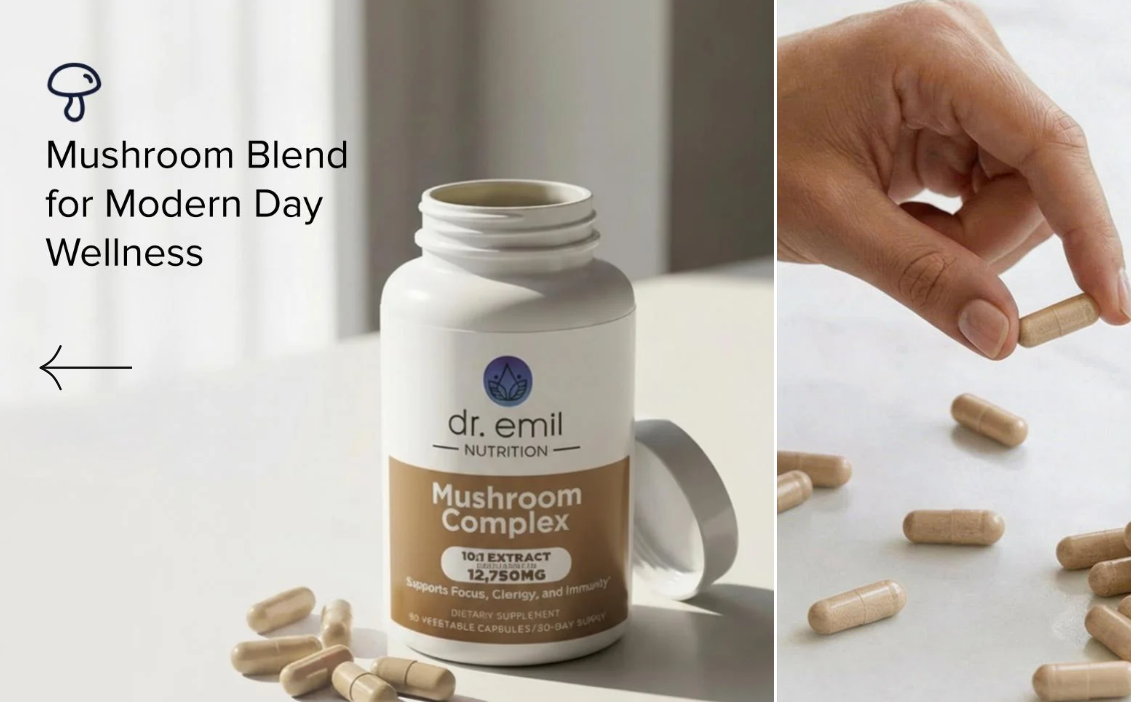
Ultimately, What Is Agarikon Mushroom? The Rare Ingredient In Our Mushroom Complex is a question best answered with both enthusiasm and perspective. Agarikon is an unusual mushroom with a fascinating history and promising preliminary research. Its inclusion in a thoughtfully formulated mushroom complex can broaden the range of functional mushroom ingredients, while responsible supplementation means recognizing that research is still developing.

Is Agarikon Mushroom Worth A Closer Look?
A Rare Mushroom With An Interesting History And Promising Research—But More To Learn
Agarikon is certainly an intriguing addition to the world of functional mushrooms. Its unusual growth habits, long history of traditional use, and distinctive collection of naturally occurring compounds help explain why this rare mushroom continues to attract scientific and wellness interest.
At the same time, the most credible answer to what is Agarikon mushroom is not that it is a miracle ingredient. Much of the research remains preliminary, and laboratory findings cannot automatically be translated into proven benefits for people. More well-designed human studies are needed to determine exactly how Agarikon supplementation may affect health.
That does not make Agarikon irrelevant. Its unique profile can make it a compelling ingredient in a thoughtfully formulated mushroom complex, particularly when paired with better-studied functional mushrooms. The key is to view the formula as a whole and choose products that provide transparent labeling, appropriate ingredient information, and meaningful quality controls.
Ultimately, Agarikon is best appreciated for what the evidence currently supports: a rare, historically significant mushroom with promising scientific potential and plenty of room for further discovery. For consumers interested in mushroom supplements, that combination makes it worth knowing about—without requiring exaggerated health claims.