
When comparing Maitake vs. Reishi, it can be tempting to look for one clear winner. But the more useful answer is that both mushrooms offer intriguing benefits, and the better choice depends largely on your individual wellness goals.
Maitake is particularly interesting for people focused on immune and metabolic wellness. Reishi has a long-standing reputation for promoting calm, balance, and overall well-being, while also receiving scientific attention for its immune and antioxidant properties.
The conclusion of this article is straightforward: neither mushroom is universally “better.” Maitake and reishi have different strengths, and both can have a valuable place in a thoughtful supplement routine. In some cases, they may even complement one another.
To support that conclusion, we'll examine the unique compounds and potential benefits associated with maitake, including its beta-glucans and research surrounding immune and metabolic health.
We'll then explore reishi's traditional uses and modern research, particularly its connection to relaxation, stress support, immune function, and overall balance.
The comparison will also look at where the mushrooms overlap, how their potential benefits differ, and whether taking them together makes sense. Finally, we'll discuss how to choose a mushroom based on your personal wellness priorities and what to look for in a quality supplement.
Rather than treating Maitake vs. Reishi as a competition, this article takes a more practical approach: understand what each mushroom brings to the table, then decide which—or whether both—fits your goals.
In this article, we’ll break down:
- Maitake Vs. Reishi: Which Mushroom Should You Take, And For What?
- Maitake Benefits: What Makes This Mushroom Unique?
- Reishi Benefits: The Mushroom Traditionally Linked To Calm And Wellness
- Maitake Vs. Reishi: How Their Benefits Compare
- Maitake For Immune Support Vs. Reishi For Stress Support
- Can You Take Maitake And Reishi Together?
- How To Choose The Right Mushroom For Your Wellness Goals

Maitake Vs. Reishi: Which Mushroom Should You Take, And For What?
A Side-By-Side Look At Two Powerful Functional Mushrooms
Q: What Is The Main Difference Between Maitake And Reishi?
A: Both are functional mushrooms with long histories of traditional use, but they are often associated with different wellness goals. Maitake is particularly studied for immune and metabolic health, while Reishi is widely researched for immune function, stress response, and overall balance.
Q: Is Maitake Good For Immune Support?
A: Maitake contains polysaccharides, including beta-glucans, that have attracted scientific interest for their potential effects on immune activity. Research is promising, although more human studies are needed.
Q: What Is Reishi Traditionally Used For?
A: Reishi has traditionally been used to promote calm, resilience, and general wellness. Modern research has also examined its immune-modulating and antioxidant properties.
Q: Can Maitake And Reishi Be Taken Together?
A: They can potentially complement one another because they offer different profiles of bioactive compounds. However, people taking medications or managing health conditions should consult a healthcare professional before combining supplements.
Q: Which Mushroom Is Better For Stress?
A: Reishi is generally the more popular choice when relaxation and stress support are priorities.
Q: Which Is Better For Metabolic Wellness?
A: Maitake has received particular interest for metabolic markers, although supplementation should complement—not replace—a healthy diet and lifestyle.
Q: Which Mushroom Should You Take?
A: There is no universal winner. Maitake vs. Reishi: Which Mushroom Should You Take, and For What? is best answered by matching each mushroom to your individual wellness priorities.
Maitake Benefits: What Makes This Mushroom Unique?
Discovering The Immune And Metabolic Potential Of Maitake
Maitake, sometimes called “hen of the woods,” is a culinary and functional mushroom recognized for its distinctive clustered appearance. Beyond its role in food, maitake has become popular in supplements because of its naturally occurring polysaccharides and other bioactive compounds.
One of the biggest areas of interest surrounding maitake is immune function. Its beta-glucans have been studied for their ability to interact with components of the immune system. Rather than simply “boosting” immunity, these compounds are more accurately described as potentially influencing or modulating immune activity.
Maitake has also attracted attention for metabolic wellness. Preliminary research has investigated potential relationships between maitake compounds and healthy blood sugar, insulin sensitivity, blood pressure, and lipid metabolism. These findings are interesting, but they should not be interpreted as evidence that maitake treats metabolic disease.
For wellness-minded adults, potential areas of interest include:
- Immune system support
- Metabolic health
- Antioxidant activity
- Nutritional variety
The broader appeal of maitake is its versatility. It can be enjoyed as a food while concentrated extracts provide another way to incorporate its bioactive compounds.
When considering Maitake vs. Reishi, maitake may be especially appealing to people whose primary interest is immune and metabolic wellness.

Reishi Benefits: The Mushroom Traditionally Linked To Calm And Wellness
Exploring Reishi’s Longstanding Reputation For Balance And Relaxation
Reishi has earned a unique reputation among functional mushrooms. Sometimes called the “mushroom of immortality” in traditional Chinese medicine, reishi has historically been valued for supporting overall vitality and balance.
Modern research has investigated several of its compounds, including polysaccharides and triterpenes. Scientists are particularly interested in reishi's potential antioxidant and immune-modulating properties. Research has also explored its relationship with sleep, stress, and general feelings of well-being.
Reishi should not be viewed as a pharmaceutical treatment for anxiety, insomnia, or other medical conditions. Instead, it may have a place within a broader wellness routine for people looking for a calming functional mushroom.
This makes reishi an interesting counterpart to maitake. While both mushrooms contain potentially beneficial polysaccharides, reishi's traditional reputation and modern research make it especially attractive for people interested in relaxation and overall resilience.
Another benefit is versatility. Reishi can be found in capsules, powders, teas, tinctures, and standardized extracts. Product quality varies, so consumers should look for transparent labeling and reputable manufacturing practices.
In the Maitake vs. Reishi comparison, reishi may be the more natural fit for someone prioritizing calm, stress management, and general wellness while still wanting the potential benefits associated with functional mushrooms.
Maitake Vs. Reishi: How Their Benefits Compare
Understanding The Similarities And Differences Between These Mushrooms
Comparing maitake and reishi is less about finding a single “best” mushroom and more about understanding what makes each one distinctive. Both contain beta-glucans and other compounds that have attracted scientific interest, but their traditional applications and research profiles differ.
Maitake is commonly associated with immune and metabolic wellness. Reishi, meanwhile, has a particularly strong reputation for relaxation, stress support, immune modulation, and overall balance.
There is also considerable overlap. Neither mushroom should be reduced to one benefit, and both contain multiple bioactive compounds that may interact with different biological pathways. Research into both mushrooms continues to evolve, and human evidence is generally less extensive than marketing claims sometimes suggest.
A simplified comparison looks like this:
The takeaway from Maitake vs. Reishi: Which Mushroom Should You Take, and For What? is encouraging: you do not necessarily have to choose based on which mushroom is “better.” Instead, consider which profile aligns most closely with your goals.

Maitake For Immune Support Vs. Reishi For Stress Support
Matching Each Mushroom To Your Everyday Wellness Priorities
Both maitake and reishi have earned attention for their potential influence on immune health, but they are often positioned differently within wellness routines.
Maitake is particularly interesting because its beta-glucans have been studied for their interactions with immune cells. Research also makes maitake appealing to people interested in metabolic wellness, giving it a relatively broad nutritional profile.
Reishi has a different traditional identity. It has long been associated with calm and balance, and modern researchers have investigated its potential effects on stress-related wellness, sleep quality, and immune function.
That distinction does not mean maitake is only for immunity or reishi is only for stress. Both mushrooms contain multiple compounds, and research continues to explore their broader effects.
Instead, think about your primary wellness priority. Someone building a routine around immune and metabolic support may naturally gravitate toward maitake. Someone looking for a functional mushroom associated with relaxation and overall balance may prefer reishi.
Importantly, neither should be presented as a replacement for medical treatment. Supplements work best when they complement foundational habits such as nutritious eating, regular physical activity, adequate sleep, and effective stress management.
This makes the Maitake vs. Reishi question more personalized than competitive: both mushrooms can have a valuable place in a thoughtful wellness routine.
Can You Take Maitake And Reishi Together?
Why Combining Functional Mushrooms May Offer Complementary Benefits
Because maitake and reishi have overlapping but distinct profiles, some people are interested in using them together. There is a reasonable nutritional rationale for combining functional mushrooms, particularly when the goal is broader wellness rather than targeting a single concern.
Maitake brings considerable interest in immune and metabolic support, while reishi is especially associated with calm, balance, immune modulation, and antioxidant activity. Combining them could therefore provide a broader range of mushroom-derived compounds than choosing either one alone.
However, “more” does not automatically mean “better.” There is limited research specifically evaluating every combination, dose, and extract available in commercial supplements. Consumers should also consider the total amount of each ingredient rather than assuming a combination product is automatically superior.
If you are considering both, look for products that clearly disclose:
- Mushroom species and extract type
- Amount of each mushroom per serving
- Manufacturing and quality-testing information
People taking prescription medications, managing chronic conditions, preparing for surgery, or dealing with allergies should discuss mushroom supplements with a healthcare professional before starting them.
If you are looking for a place to get a safe and natural dose of maitake and reishi mushrooms to incorporate into your self care routine then be sure to check out our Dr. Emil’s Mushroom Complex!
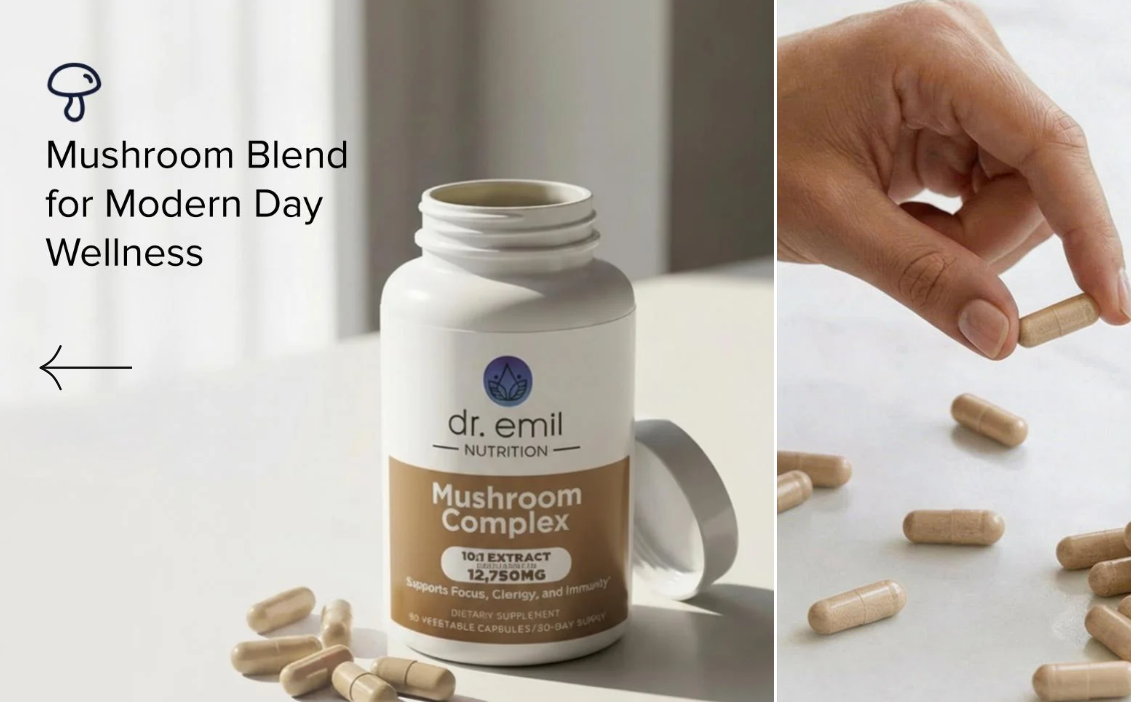
Ultimately, Maitake vs. Reishi does not have to be an either-or decision. For some healthy adults, combining complementary mushrooms may be a practical way to incorporate different functional mushroom profiles into one wellness strategy.

How To Choose The Right Mushroom For Your Wellness Goals
Finding A Place For Maitake, Reishi, Or Both In Your Routine
Choosing between maitake and reishi becomes easier when you start with your personal wellness priorities instead of asking which mushroom is universally superior.
If immune and metabolic wellness are your primary interests, maitake may be an appealing option. Its polysaccharides and beta-glucans have generated considerable research interest, while its culinary history makes it a familiar functional food.
If relaxation, stress support, and overall balance are higher priorities, reishi may be the more natural fit. Its traditional reputation and ongoing research into immune and antioxidant activity make it one of the best-known functional mushrooms.
For people interested in broader mushroom supplementation, taking both may also be worth considering, provided the products are appropriate and there are no medication or health-related concerns.
Whatever your choice, product quality matters. Look for clear ingredient labels, identifiable mushroom species, appropriate extraction information, and reputable manufacturing practices.
The most important takeaway from Maitake vs. Reishi: Which Mushroom Should You Take, and For What? is that there is no need to declare one mushroom the winner. Maitake and reishi offer different but potentially complementary strengths.
Rather than choosing based on hype, match the mushroom to your goals and use it as one part of a balanced approach to wellness. Both can be valuable additions to a thoughtful supplement routine when expectations remain realistic and evidence stays at the center of the decision.

Maitake Vs. Reishi: Which One Is Right For You?
Finding The Functional Mushroom That Fits Your Wellness Goals
So, when it comes to Maitake vs. Reishi: Which Mushroom Should You Take, and For What?, there is no universal winner. Both mushrooms have distinctive qualities that can make them worthwhile additions to a well-rounded wellness routine.
Maitake stands out for its research interest surrounding immune and metabolic health. Its naturally occurring beta-glucans and other compounds make it particularly appealing to people looking for nutritional support in these areas.
Reishi offers a different profile. Its long history of traditional use, combined with modern research into immune modulation, antioxidant activity, relaxation, and overall balance, makes it an appealing choice for people seeking a more calming functional mushroom.
The good news is that choosing one does not necessarily mean rejecting the other. Depending on your goals and individual circumstances, maitake and reishi may provide complementary benefits when incorporated responsibly.
As with any supplement, quality and realistic expectations matter. Look for reputable products with transparent labeling, and speak with a healthcare professional if you take medications or have an underlying health condition.
Ultimately, the best mushroom is the one that aligns with your wellness priorities. Whether you choose maitake, reishi, or a combination of both, each offers an intriguing way to explore the potential benefits of functional mushrooms.